
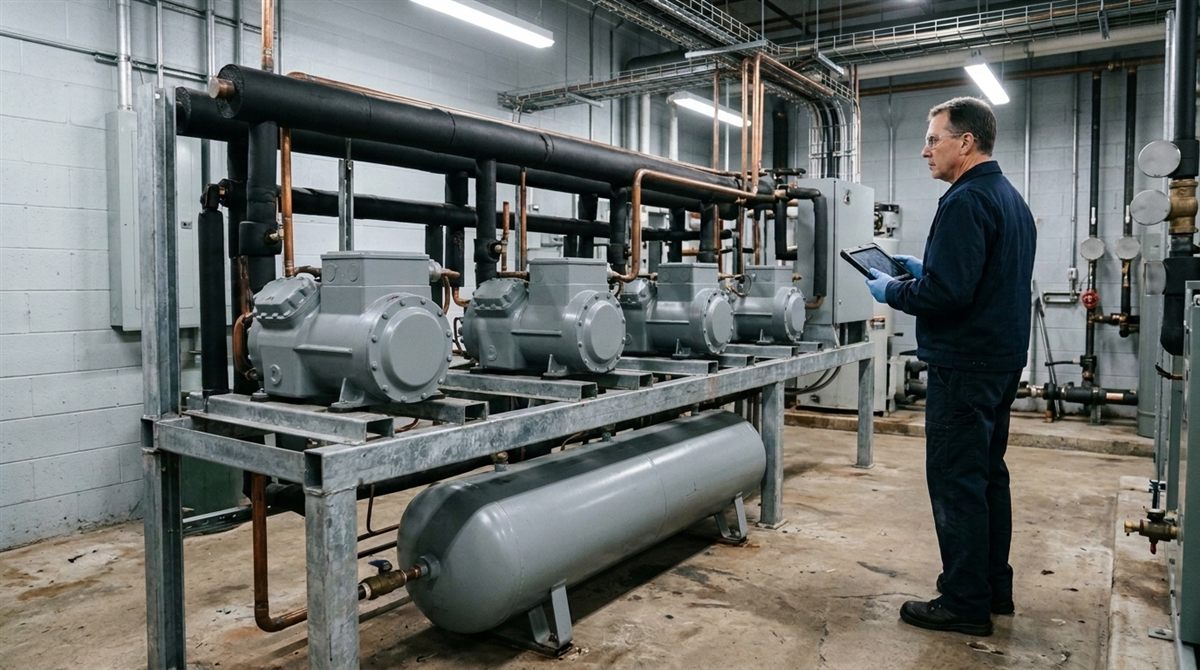

A supermarket's facilities director wants to know why one August top-up on a single rack circuit set a federal repair deadline, when the year's top-ups came to less than a tenth of its charge. The answer is in the log: under EPA's rule the rate is worked out at each top-up, and the August top-up came only 91 days after the one in May.
The circuit sits on the store’s low-temperature rack, and it runs on R-448A. The service engineer topped it up three times this year: 9 lb in March, 12 lb in May and 34 lb in August. Add those up and you get 55 lb, under 9% of the circuit’s 620 lb full charge. So why did August set a deadline? Because under EPA’s rule the refrigerant leak rate is not the year’s top-ups added together.
The rule has the rate worked out every time refrigerant is added, as the share of the full charge the circuit would lose in a year if it kept leaking at the current pace. The store works it out with the annualizing method, one of the rule’s two methods. August’s top-up came just 91 days after May’s, and that put the circuit at 22.0%. The rule sets a threshold of 20% for commercial refrigeration, and the August top-up took the circuit over it. The store and the people in it are not real. The store, its circuit and its log are an example built for this guide.
In this example the store is in the United States, so the rule it follows is the federal one made by the U.S. Environmental Protection Agency (EPA). A store in another country follows that country’s own refrigerant rules, and a state may add rules of its own, which this guide does not cover.
The short answer: Under EPA’s federal rule in the United States, the leak rate is worked out every time refrigerant is added. It is the share of the full charge the circuit would lose in a year if it kept leaking at that pace, not the total of the year’s top-ups. The store, as the owner of the equipment, is responsible for working it out at each top-up, using the same one of the rule’s two methods for every covered appliance at the site, and if a commercial refrigeration circuit goes over 20%, the store has 30 days to find and repair the leaks and pass the initial verification test. Before the next top-up on a circuit you service, check that the circuit’s full charge and the method the store uses are written down.
Where the 20% threshold comes from
The threshold comes from 40 CFR Part 84, Subpart C, a federal regulation of the U.S. Environmental Protection Agency under the American Innovation and Manufacturing (AIM) Act of 2020. Its leak repair section has applied “as of January 1, 2026”. It covers appliances holding 15 lb or more of refrigerant that contains a regulated substance, and the HFCs in R-448A are on the rule’s list.
A supermarket rack is commercial refrigeration, so its threshold is 20%. Industrial process refrigeration gets 30%, and comfort cooling and other appliances get 10%. The rule also counts by circuit: “each independent circuit is considered a separate appliance”. So every circuit on the store’s rack has its own leak rate.
The arithmetic is the store’s job. The rule says “The owner or operator must calculate the leak rate every time refrigerant is added”. Your engineer may well run the numbers at the unit, and many firms do. The duty still stays with the store, and so does the choice of method.
Two other rules sit at the edge of this one. EPA’s older Section 608 leak repair rule has covered only ozone-depleting refrigerants since April 10, 2020, so a rack that runs on HFCs falls under this rule instead. And the requirement for automatic leak detection starts at 1,500 lb, well above this 620 lb circuit.
Two ways to calculate the refrigerant leak rate, and the store picks one
The rule gives two methods, and one condition applies to both: “The same method must be used for all appliances subject to the leak repair requirements located at an operating facility.”
- Annualizing method: (lb added ÷ full charge) ÷ (days since the last addition, at most 365, ÷ 365) × 100. The pounds are the ones added to bring the circuit back to full charge. The store uses this method for every covered appliance on site.
- Rolling average method: (lb added over the previous 365 days ÷ full charge) × 100. If the last successful follow-up verification test that showed all leaks repaired was less than 365 days ago, the count starts from that test instead.
The two methods can tell very different stories. On the rolling average method, the circuit’s August figure would be 8.9%, because 55 lb had gone in since January 1 against a full charge of 620 lb. That is why the method goes on every service record. An owner may switch only after buying a facility that used the other method, and the change has to be recorded.
Both methods divide by the full charge, so that figure has to be on file first. The rule allows four ways to set it, alone or combined: the manufacturer’s figure, a calculation from component sizes and piping, the amounts measured as they go in or out, or the midpoint of an established range. For appliances of 15 lb or more it was due “By January 1, 2026, or upon installation”. The store’s file gives this circuit 620 lb, calculated from its components and piping.
The circuit’s refrigerant leak rate at each top-up
The table works the circuit’s four additions of 2026 on the annualizing method. The dates and amounts are the example’s. Each top-up brought the circuit back to full charge in one addition, and the log shows no other addition this year. March was the first addition after January 1, 2026, so the rule counts that gap as 365 days.
| Date of addition (example) | R-448A added (lb) | Added ÷ 620 lb full charge | Days since the last addition (365 at most) | Days ÷ 365 | Leak rate, annualizing method (%) | Against the 20% threshold |
|---|---|---|---|---|---|---|
| March 10, 2026 | 9 | 0.0145 | 365 (first addition after Jan 1, 2026) | 1.0000 | 1.5 | Under |
| May 19, 2026 | 12 | 0.0194 | 70 | 0.1918 | 10.1 | Under |
| August 18, 2026 | 34 | 0.0548 | 91 | 0.2493 | 22.0 | Over: the repair period starts |
| October 27, 2026 | 3 | 0.0048 | 70 | 0.1918 | 2.5 | Under: the repair is confirmed |
May’s 12 lb looked small. But it came only 70 days after March, so the rate jumped to 10.1%. August’s 34 lb came 91 days later and pushed the circuit past 20%. October’s top-up, after the repair, worked out at 2.5%.
Over the year, the four top-ups total 58 lb, or 9.4% of the full charge. That calendar-year total is the figure the rule uses to find chronic leakers. An appliance of 15 lb or more that leaks 125% or more of its full charge in a calendar year is one, and the owner reports it to EPA by March 1 of the following year. Since leak repair began on January 1, 2026, the first reports fall due by March 1, 2027. That date comes from reading two clauses together; the rule does not print it. This circuit sits far below the line.
What the store had to do after the August top-up
The August top-up brought the circuit back to its charge, but it did not fix the leak. The rule gives 30 days from the addition that took the rate over 20% to identify and repair the leaks, starting with a leak inspection by a certified technician. How to find and repair the leak and recharge the circuit is a matter for the certified technician and the equipment’s instructions, and this guide does not cover it.
So a top-up that takes a commercial refrigeration circuit over 20% starts a 30-day clock to repair the leaks and pass the initial verification test, and for this circuit that deadline was September 17.
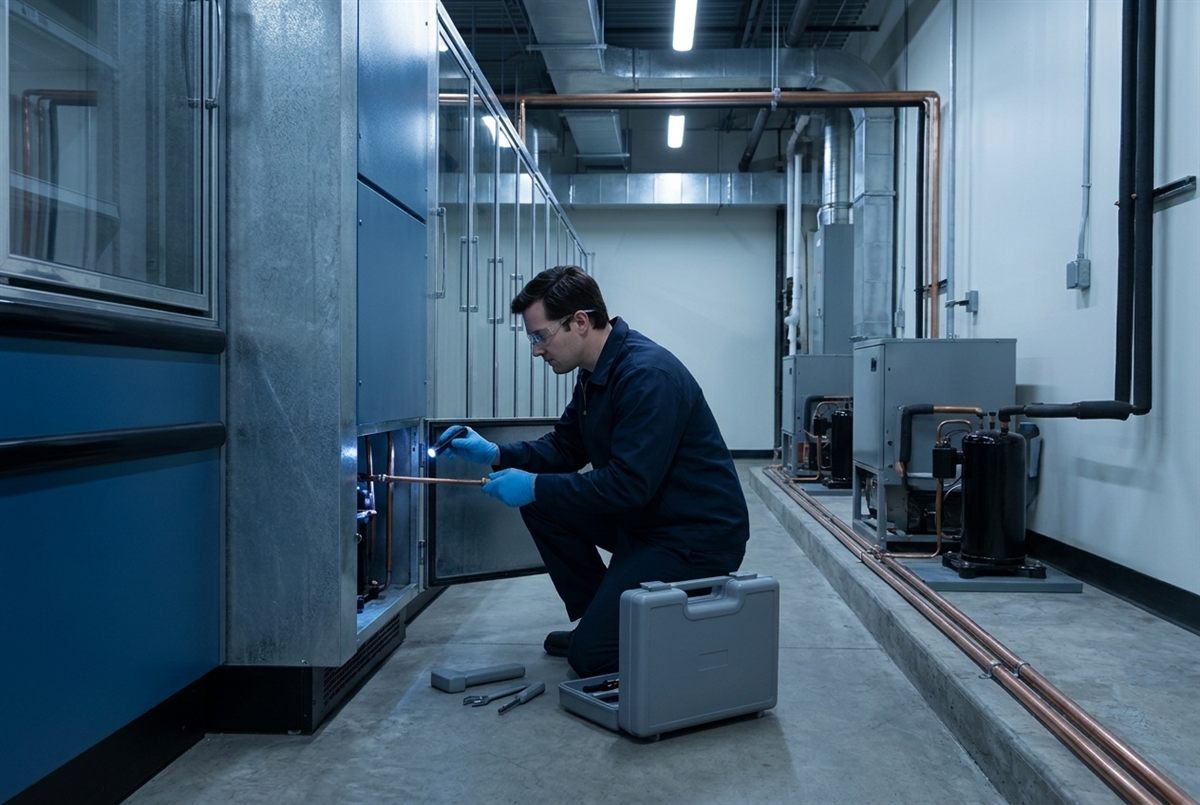
Two tests then show whether the repair held. The initial verification test falls within the same 30 days, and the follow-up comes within 10 days of a successful initial one. At the store, the August 20 leak inspection found a leak at a joint on a copper line behind the frozen food cases. The technician repaired it on August 26 and passed the initial test that day. The follow-up passed on September 2.
After the repair
The leak stays on the record as not yet repaired until the repair and both tests are written down, and a top-up on its own never counts as the repair. Next come the routine inspections. A commercial refrigeration appliance of 500 lb or more needs one “once every three months after the date of a successful follow-up verification test”, until the circuit stays under its threshold for four quarters in a row. For this circuit, the first one was due by December 2.
The next addition confirms the repair. The rule takes that confirmation from “the leak rate calculation performed upon the next refrigerant addition”, and the October 27 top-up gave it, at 2.5%. Had the store not repaired, or had the circuit stayed above 20% after repairs and tests, the rule would ask for a retrofit or retirement plan within 30 days.
What the service record has to show
For each service visit, the rule lists eight items. The first five cover the appliance’s identity and location, the date, the parts worked on, the type of work on each part and the name of the person doing it. The sixth is “The amount and type of refrigerant added”. The last two are the full charge and “The leak rate and the method used to determine the leak rate”.
Your firm gives the store the first six “upon conclusion” of the work, along with the leak inspection and verification test details. The full charge and the leak rate with its method belong to the owner’s record. The rule asks for records “for at least three years in electronic or paper format”. Your firm remains responsible for its engineers’ credentials, the refrigerant it handles and the records it keeps; the duties the rule places on the owner, from the calculation to the repair, stay with your client.
Four top-ups, one repair and an inspection still due
The low-temperature circuit’s record for the year now has four dated top-ups: 9, 12, 34 and 3 lb. Between them sit one repair on August 26, two passed tests and an inspection due by December 2. Whoever services the rack next starts from those entries, not from memory.
NINETY-ONE DAYS APART
Leave out one date, and the leak rate comes out wrong.
The circuit’s 22.0% rests on two dated entries, 91 days apart, and a full charge on file. Frigalto was built to keep the Refrigerant Record for every circuit. It holds the refrigerant, the charge, each recovery, leak check and top-up, and who logged each one and when, and the record can be exported for each unit, building or service agreement. Frigalto keeps the refrigerant and maintenance records your firm needs. It does not certify technicians, and it does not check the certificate details your team types in.
Sources and references
- U.S. Environmental Protection Agency, “40 CFR 84.102 Definitions”, Part 84 Subpart C, “Leak rate”, “Full charge”, “Commercial refrigeration” and “Refrigerant-containing appliance”, eCFR current to November 5, 2026, read November 9, 2026. ecfr.gov
- U.S. Environmental Protection Agency, “40 CFR 84.106”, paragraphs (a), (b), (c)(2), (d), (e), (g), (h), (j) and (l), eCFR current to November 5, 2026, read November 9, 2026. ecfr.gov
- U.S. Environmental Protection Agency, “40 CFR Part 84, Appendix A”, regulated substances, eCFR current to November 5, 2026, read November 9, 2026. ecfr.gov
- U.S. Environmental Protection Agency, “40 CFR 84.108 Automatic leak detection systems” and “40 CFR 84.1 Purpose and scope” (the AIM Act, Public Law 116-260), eCFR current to November 5, 2026, read November 9, 2026. ecfr.gov
- U.S. Environmental Protection Agency, “40 CFR 82.157”, paragraph (a), Section 608 leak repair, eCFR current to November 5, 2026, read November 9, 2026. ecfr.gov